Living Computers closed, but its spirit and vintage machines live on at a museum south of Seattle
Stephen Jones, caretaker of the Interim Computer Museum, with a DEC PDP-6 and its round Type 340 display, which volunteers are restoring. The monitor above the console shows SHRDLU, a 1960s AI program, running in an…
 GeekWire
When Seattle’s Living Computers: Museum + Labs closed for good in 2024, it seemed like the end of the line for anyone who wanted to do more than just look at old computers.
But in a Tukwila business park 20 minutes south of downtown, a sizable collection of vintage computers is still alive — kept running by a few of the same people who once did the same for Paul Allen.
The Interim Computer Museum is a nonprofit that opened to the public in 2024 and has quietly grown into a hands-on showcase of dozens of machines, from early Apples and IBM PCs to hulking DEC systems that once filled university labs. At 4,400 square feet of public space, it’s nearly as big as Living Computers was before that museum expanded in 2016.
ICM is led by Stephen Jones, who calls himself the museum’s “caretaker.” Jones spent two decades helping track down and restore machines for Allen, first at PDP Planet, Allen’s private collection of vintage systems, then at Living Computers, where he was senior engineering manager.
When the late Microsoft co-founder’s estate wound down Living Computers, the majority of the collection went to the Mimms Museum of Technology and Art in Georgia, where Jones is also a curator. The machines in Tukwila are privately owned, and Jones has helped bankroll ICM with personal funds, with plans to eventually donate the collection to the nonprofit.
The Mimms museum now holds the Living Computers trademark and has granted ICM “legacy use” of the name, but Jones said he didn’t want to revive it as ICM’s own because “it has a finite past.” Instead, he wants to carry on “the spirit of the engineering focus.”
“Between Mimms and here, this is the legacy,” Jones said. “We show the name and the connection to the past, but we’re doing new things.”
Down the street from DOS

ICM occupies space in Seattle Exchange @ Southcenter, a sprawl of low-slung flex buildings off Strander Boulevard near Westfield Southcenter mall. Its neighbors include a car detailer, a pest control company, a welding shop, an embroiderer and an upholsterer.
More than four decades ago, Seattle Computer Products operated just down Industry Drive. That’s where Tim Paterson wrote 86-DOS, the operating system Microsoft bought and turned into MS-DOS for IBM’s first PC.
Jones calls that proximity part of the “magic” of the location. The museum has a Gazelle computer that SCP built nearby, using boards that Jones said the company hired high school students to assemble and test. Volunteers recently pulled data off its hard drive, which boots into MS-DOS 2.11 and still holds SCP’s own source code.
Allen’s fingerprints are everywhere. One display holds a 1971 letter from Hellmut Golde, director of the University of Washington’s Computer Science Laboratory, kicking Allen and his “friends from the Lakeside School” out of the lab. Among the offenses: tying up the teletypes to print “endless listings,” and taking an acoustic coupler from a professor’s office “without leaving at least a note.” Golde asked them to turn in their keys.
The letter sits beside an Imlac PDS-1, the same type of graphics computer Golde scolded the teens for using without permission. More than five decades later, the letter is headed back to campus: ICM plans to display it, along with the Imlac, at UW’s 60th anniversary celebration for its computer science program in March.

Jones recalled that Allen insisted visitors to Living Computers get “the 10-minute experience” of loading an Altair 8800 from paper tape, just as he remembered it. The kit computer was the machine for which Allen and Bill Gates wrote Microsoft’s first product, and Allen wanted to reinforce “how far we’ve come and how difficult old computers were.” ICM has an Altair 8800 on display.
Around the corner is Miss Piggy, a DEC datasystem 570 that Microsoft used in the early 1980s to support the group that built Multiplan, Word and later Excel. It was also the email host for much of the company, including Gates, who once had to print out an important message on its console printer when the system went down before a speaking engagement.
Recovered email shows Allen pushing to get Piggy networked. “Paul Allen is very keen on doing this,” Henry Burgess wrote in 1982. Retired in 1986, the machine now runs again in Tukwila. It’s one of ICM’s most popular remote systems, and some fans come in just to write programs while sitting next to it.
Other local ties include a PDP-7 that Boeing used to process flight data in the 1960s, and a Toad-1, a modern take on the PDP-10 built in the 1990s by Redmond’s XKL. Jones first got involved with Allen’s world through a 1997 Usenet post inviting PDP-10 enthusiasts onto a Toad. That machine became the cornerstone of PDP Planet.
In a 2024 video for Christie’s, Jones said what inspired Allen was “being able to recover old programs, mythical code, and get them running on hardware so that they can be studied.”
Asked what Allen would make of ICM, Jones didn’t hesitate. “I think he’d be happy,” he said.
‘Sorry, I don’t know’

On a monitor beside ICM’s PDP-6, a 1968 artificial intelligence program is having trouble.
“SORRY, I DON’T KNOW THE WORD ‘STEEPLE,'” it replies.
The program is SHRDLU, created by Terry Winograd at the MIT AI Lab. It let a user type plain-English commands to move blocks around a virtual world. Only the PDP-6’s front console and display survived, so ICM is rebuilding the machine as a “hybrid,” with the original hardware wired to an emulator.
Jones sees a lesson in that old error message. “You look at this and you think of how we use ChatGPT now,” he said. “The cool thing about SHRDLU is that it can tell you ‘I don’t know.’ It doesn’t try to fabricate anything.”
Related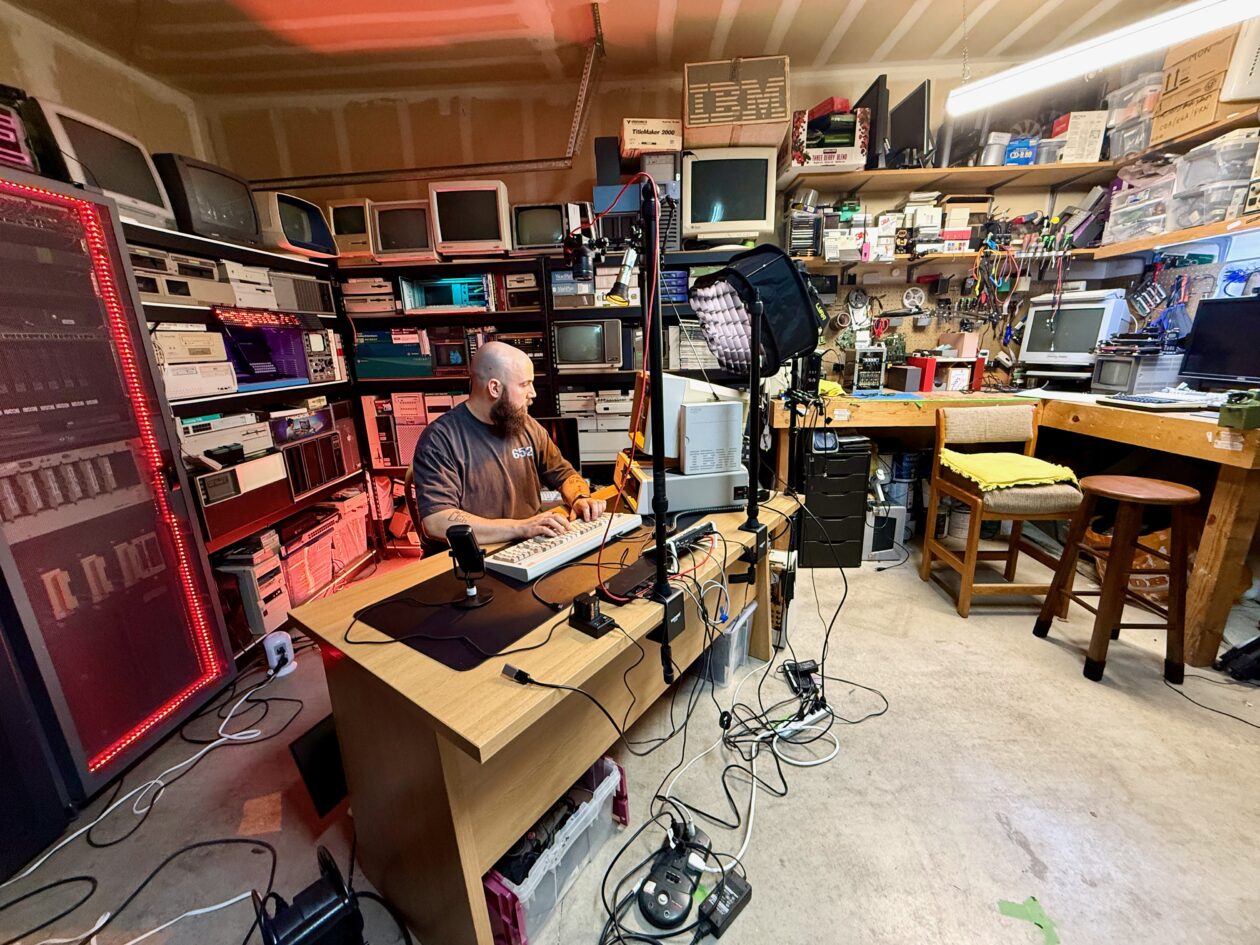 Retro tech meets modern AI: Inside an Amazon developer’s garage turned working computer museum
ICM has its own ties to the modern AI world. An Anthropic employee is a member and strong supporter, and in October the museum brought six vintage computing stations to an Anthropic event, where the company’s Claude chatbot wrote programs for machines like the Commodore 64.
Back in Tukwila, Claude has become one of ICM’s most useful restoration tools. The team feeds it huge stacks of scanned documentation, such as the full set of schematics for a PDP-10. When a machine has a logic fault, they ask where to look, and Claude points them to a page in the maintenance manual or a likely bad module.
“That’s turned things that would take a couple of weeks to solve into a couple of days,” Jones said.
AI can point the way, but the repairs remain hands-on work. When Miss Piggy wouldn’t run properly this year, former Living Computers engineer Josh Dersch stepped through the machine’s microcode one instruction at a time using a recreated DEC test board, until he found a single bad chip. A spare board brought it back.
Asked if it still takes a human to keep these machines running, Jones agreed — at least for now. If a humanoid robot with AI built in ever shows up to do the repairs, he joked, “then I sit at the front desk all day.”
Everything is interim

Nearly everything at ICM is meant to be touched, switched on and played with, and that can be intimidating. On machines with nothing but a text prompt, “you kind of have to know the commands in your head already,” Jones said.
That’s by design. From the start, the idea was to challenge people “either by confronting them with their past or demonstrating how difficult it was,” Jones said. His example: two friends, one with an Apple IIe and one with an IBM PC, whose computers “could never share” software. ICM continues that legacy, he said, “challenging the visitor to go beyond what they might feel comfortable with.”
Volunteers have written cheat sheets to help newcomers, and Jones is encouraged when families come in and kids start typing BASIC programs. “That to me was the spirit of what PDP Planet and Living Computers was meant to be,” he said.
Very little is behind glass. Jones jokes that a Timex Sinclair 1000, which would wipe your painstakingly typed program if you bumped it, is “the only computer that deserves to be behind glass.” The goal, he said, is to avoid “a boneyard that people walk through.”
Other highlights include Galaxy Game, the first coin-operated video game, installed at Stanford in 1971 and now being restored, and a Thinking Machines CM-2 supercomputer, whose 40th anniversary ICM just celebrated with members of its original design team.

For younger engineers raised on modern tools, Jones has a go-to move. He asks if they’ve used Linux, then walks them over to the PDP-7, the type of machine Unix was first written on more than 50 years ago. Many of the basic commands they type every day started there.
The collection totals about 6,000 artifacts. Volunteers are also slowly working through roughly 3,000 magnetic tapes and disk packs from Living Computers’ software preservation program. And ICM keeps 32 historic systems online, where members can log in from anywhere to use vintage operating systems, programming languages and games.
That remote access helps explain why ICM has about 500 members and sponsors, even though only 81 members have visited in person this year. Memberships start at $36 a year. Along with a King County grant through 4Culture, they help cover rent, with personal funds from Jones filling the gap. The museum hopes to become self-sustaining within five years, and maybe someday buy its own building.
The museum’s name reflects the urgency. “We’re in this magic window right now, where the hardware can still run, we can still maintain it, you can replace parts,” Jones said. “But slowly we’re getting further and further away.”
ICM is open Saturdays through Mondays from 10 a.m. to 4 p.m. Admission is $9 for adults and free for those under 18. Last May, the museum revived Vintage Computer Festival Pacific Northwest, which had been canceled in March 2020. The event drew 981 people, and it returns May 1–2 at the Tukwila Community Center.
Among the machines on the floor is MIT-AI, a DECsystem-2020 that once served as the ARPANET host for MIT’s Artificial Intelligence Lab. As Living Computers shut down in 2024, Christopher Zach, who sold the machine to Allen, told GeekWire he was ready to drive a U-Haul to Seattle to rescue it.
He can stay home.
When a friend of Zach’s stopped by ICM’s booth at WorldCon and asked about “Chris’s computer,” Jones had a simple message to pass along: “Please just tell him it’s safe.”
// RELATED
 Techmeme
TrustedRouter, which raised $6M to offer E2EE and confidential computing for enterprise AI queries, says it processes 6B+ tokens per day, up from 1B in August (Davey Alba/Bloomberg)
Davey Alba / Bloomberg : TrustedRouter, which raised $6M to offer E2EE and confidential computing for enterprise AI queries, says it processes 6B+ tokens per day, up from 1B in August — The startup offers…
 Techmeme
OpenAI says it corrected a GPT-6.2 Astra and Sol launch billing mistake that had incorrectly discounted usage; Astra users will now hit their limits 40% faster (Graham Barlow/TechRadar)
Graham Barlow / TechRadar : OpenAI says it corrected a GPT-6.2 Astra and Sol launch billing mistake that had incorrectly discounted usage; Astra users will now hit their limits 40% faster — Too little, too late?…
 Techmeme
Analysis: institutional investors are selling stakes in older VC funds from the 2021 investment boom peak at steep discounts and rushing to back new AI funds (Financial Times)
Financial Times : Analysis: institutional investors are selling stakes in older VC funds from the 2021 investment boom peak at steep discounts and rushing to back new AI funds — Pension funds and endowments ditch…
 404 Media
All the Worst Government GTA Memes from Around the World
Grand Theft Auto VI is a true monocultural event . Every news channel is covering it, anyone with a passing interest in video games is playing it, and it’s made almost $4 billion in less than a week. Desperate to…
 Techmeme
Sources: Z.ai's 3T-parameter flagship GLM-5.5 missed its November release and could be delayed to Q1 2027 or later due to US rules and labs' distillation curbs (Reuters)
Reuters : Sources: Z.ai's 3T-parameter flagship GLM-5.5 missed its November release and could be delayed to Q1 2027 or later due to US rules and labs' distillation curbs — China's Z.AI has fallen behind schedule…
 Techmeme
Thariq Shihipar joins OpenAI after leaving Anthropic in October, saying he felt he could "personally contribute the most" to bringing AI to the world at OpenAI (@trq212)
@trq212 : Thariq Shihipar joins OpenAI after leaving Anthropic in October, saying he felt he could “personally contribute the most” to bringing AI to the world at OpenAI — I've joined OpenAI! I'm very…